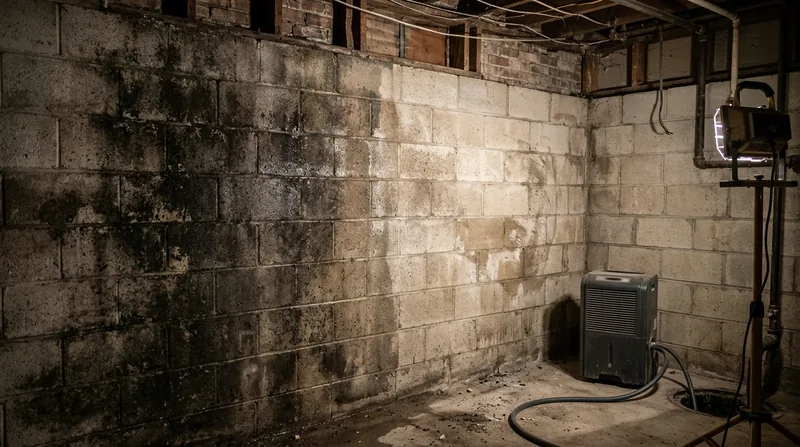




Lansing sits on glacial till and clay loam, and the Grand River and Red Cedar River floodplains keep the water table high well into spring. That means Basement Mold Remediation in Lansing almost always starts with a moisture source, not a spray bottle. The city's housing stock tells the story: 1900s brick bungalows and foursquares in REO Town, Old Town and the Westside with fieldstone or early poured walls, 1920s-1950s Capes and ranches on the Eastside and Moores Park with partly finished basements, and 1980s-2010s poured full basements out in Delta Township, Holt and Dimondale. Snowmelt, spring rain and summer storm runoff push water toward footing drains and low corners, and long freeze-thaw winters open hairline cracks that seep year after year. We find the water path, dry the space, remediate the affected materials, and fix the drainage so mold growth does not return. If you already know water is the root cause, start with basement waterproofing in Lansing and we will tie the remediation to it.
Why Basement Mold Remediation Matters in Lansing's Old and New Basements
Mold needs three things: moisture, organic material and still air. Lansing basements supply all three. Fieldstone and early block walls in Old Town and REO Town wick groundwater and hold it, framing and drywall in partly finished Eastside basements stay damp after every April thaw, and the tight poured basements in Holt and Dimondale trap humidity when a sump pump fails during a summer storm. The musty smell is the tell, and efflorescence on the wall is the receipt.
- We trace the moisture source first, because remediation without drainage work is a repeat job.
- We contain the work area with plastic sheeting and negative air pressure to keep spores out of the rest of the house.
- We remove porous materials that cannot be cleaned, including soggy drywall, insulation and wood studs.
- We treat structural surfaces with an antimicrobial and HEPA-vacuum the entire space.
- We correct the cause with drainage, sealing or dehumidification so the basement stays dry.
Every job ends with a moisture reading and a written summary of what we found and what we fixed.
Key info: A foursquare near Moores Park had a musty front room all winter. The cause was not a burst pipe, it was a blocked footing drain backing up under the slab. We remediated the lower drywall and framed the fix around an interior perimeter drain, not another coat of paint.
For official guidance on moisture and mold in homes, the U.S. EPA's mold resources page is a reliable starting point: epa.gov/mold.
How We Run Basement Mold Remediation in Lansing From Diagnosis to Dry
We do not start spraying until we know where the water comes from. On a Lansing job that means a full walkthrough of the basement, the wall base, the sump basin, the window wells and the grading outside. We read moisture with a pin meter and a thermal camera, and we smell the space with the HVAC off so we can locate the source instead of masking it. Then we build a scope that pairs the remediation with the drainage fix that stops the moisture.
- We inspect and document moisture readings, visible growth and the likely water path.
- We set up containment and negative air machines before any material comes down.
- We remove and bag affected porous materials and HEPA-vacuum the framing and surfaces.
- We treat the structural surfaces and run air scrubbers until the space is dry.
- We repair the moisture source, whether that is crack injection, drainage or a sump upgrade.
- We verify with a final moisture reading and leave a written record of the work.
The remediation is only as good as the drainage behind it, which is why we quote both together.
Key info: A 1950s ranch in East Lansing had a musty finished room and a sump that ran every spring. We remediated the lower wall, then installed a battery backup sump pump so a storm outage would not flood the basin again.
Approaches We Use for Basement Mold Remediation in Lansing
Not every damp basement needs the same scope. A hairline crack with surface growth is a different job from a fieldstone wall wicking groundwater all spring. We match the approach to the moisture source and the material affected.
| Approach | Description | Best for |
|---|---|---|
| Surface remediation | HEPA vacuum, antimicrobial treatment and air scrubbing of structural surfaces. | Light growth on block or poured walls with a known, fixable source. |
| Material removal | Containment plus removal of affected drywall, insulation and framing. | Finished basements in Eastside and Moores Park homes after a wet spring. |
| Drainage correction | Interior perimeter drain, crack injection or grading fix paired with remediation. | Recurring seepage and high water table along the Grand River corridor. |
| Humidity control | Dehumidification and ventilation sized to the basement volume. | Tight poured basements in Holt and Dimondale with condensation, not seepage. |
| Musty smell diagnostics | Moisture mapping and thermal imaging to locate the hidden source. | Odor with no visible growth, common in partly finished basements. |
We recommend the lightest approach that actually solves the moisture problem, and we say so when simple sealing is enough.
Basement Mold Remediation Cost in Lansing: What to Expect
Most residential remediation work in Lansing starts around From $1,500 for a contained single-room scope with surface treatment and air scrubbing. The number moves with the size of the affected area, how much porous material has to come out, whether the basement is finished, and whether the moisture fix (crack injection, drainage or a sump upgrade) is part of the same job. A fieldstone wall in Old Town that has been wicking for years is a bigger scope than a hairline crack in a 1990s poured wall in Holt.
We quote remediation and the moisture correction together so you see the real total, not a teaser price that leaves the cause in place. Get two or three estimates, ask each contractor to explain the moisture source they identified, and compare scopes line by line rather than comparing headline numbers. Our full pricing overview lays out how we build a quote.
What to Look For When Hiring a Basement Mold Remediation Contractor Near Lansing
Mold work is only half the job, so hire someone who understands below-grade water. Ask whether the company is licensed and insured, request a certificate of insurance, and confirm the crew that will actually be in your basement. Get two or three written estimates with the moisture source identified and the remediation scope spelled out, and check local references from similar Lansing housing stock. Ask how they handle permits if structural work or drainage alteration is involved, and check any HOA rules before exterior work begins. When you are ready to talk through your basement, contact us for a free estimate.
Basement Mold Remediation Near Me: What Lansing Homeowners Should Know
If you are searching for basement mold remediation near me in Lansing, the first question to ask any contractor is what is feeding the moisture. In this city the answer is usually the water table, a failed footing drain or a sump that quits during a storm, and no amount of surface treatment fixes that. We diagnose the source, remediate the affected materials and correct the drainage in one scope. Call (517) 220-0430 and we will walk the basement with you.
Basement Mold Remediation in Lansing: Pricing Guide
| Service | Price | Details |
|---|---|---|
| Surface remediation, single room | Starting at $1,500 | Includes containment, HEPA vacuuming, antimicrobial treatment and air scrubbing for one affected area. |
| Finished basement material removal | Starting at $2,800 | Covers removal of affected drywall, insulation and framing, with containment and disposal included. |
| Remediation plus drainage correction | On estimate | Needs an on-site look because the drainage scope (crack injection, drain tile or sump) drives the total. |
| Musty smell diagnostics | Included | Moisture mapping and thermal imaging are part of the free inspection before any work is quoted. |
| Travel | Included | In Lansing and surrounding areas, no separate call-out or mileage fee. |
| Estimate | Free | Response within 24h at (517) 220-0430, no obligation to book. |
Indicative pricing, the exact cost depends on square footage, finish, and site access. Free personalized estimate within 24h at (517) 220-0430.


