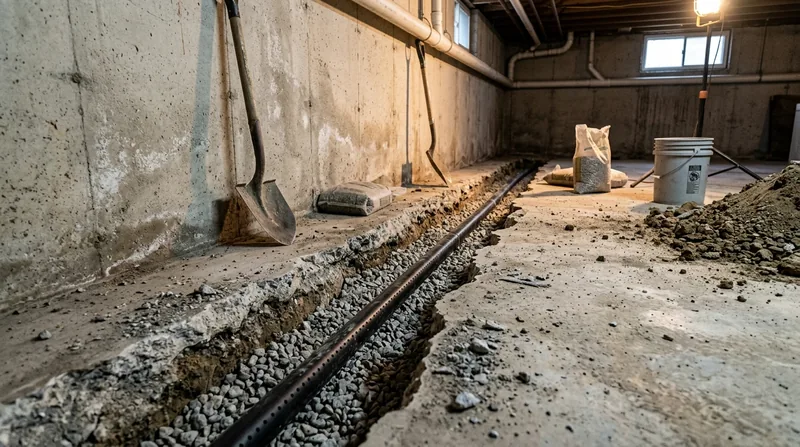




If you own a 1920s bungalow in REO Town or a 1960s ranch in East Lansing, you already know how water behaves when the Grand River and Red Cedar floodplains push the water table up through March and April. That water finds the weakest point at the wall and footing joint, seeps through fieldstone or early poured concrete, and leaves you mopping a wet basement floor every spring. An Interior Drain Tile System in Lansing is the proven fix for that specific problem: we cut the slab edge, install perforated pipe at the footing, and route every drop to a sump basin and pump. It works in glacial clay soil, it works on old block walls, and we install it in any season, including the dead of a Michigan winter. If you are still deciding between approaches, start with our basement waterproofing overview and then call (517) 220-0430 for a free inspection.
Why Interior Drain Tile Matters in Lansing's Clay and River-Flat Neighborhoods
Lansing sits on glacial till and clay loam, which drains slowly and holds water against the foundation like a sponge. In Old Town, the Westside, and Moores Park, fieldstone and early block walls were never built for a water table that climbs every spring. Hydrostatic pressure pushes water through mortar joints and hairline cracks, and no amount of exterior patching stops it once the soil is saturated. Interior drain tile relieves that pressure at the footing, where the water actually collects.
- We capture water at the wall and footing joint, the exact spot where clay soil forces it into older Lansing basements.
- We relieve hydrostatic pressure instead of fighting it with surface sealers that fail by the next spring thaw.
- We install in 1900s foursquares and 1980s Delta Township subdivisions alike, adapting the layout to slab and footing conditions.
- We keep the work below grade and inside, so your yard, landscaping, and driveway stay intact through a Michigan winter.
When the water table rises and your floor stays dry, you know the system is doing its job. For the permit side of the work, verify requirements with the City of Lansing Building Department at lansingmi.gov before work begins.
Key info: A homeowner on the Eastside near Moores Park had water pooling along the rear wall every March for six years. Three coats of sealer did nothing. An interior perimeter drain and a new sump basin solved it because the water was coming from below the slab, not through the wall face.
How We Install an Interior Drain Tile System in Lansing Homes
We start with a free basement inspection and a walk of the exterior grading, downspout extensions, and window wells. Then we map the water path: is it a single wall crack, a failed footing drain, or hydrostatic pressure across the whole perimeter? That answer decides the layout. In most Lansing basements we run a continuous interior perimeter drain along the footing, tie it into a sump basin at the low corner, and discharge through a check valve and discharge line that clears the foundation.
- We inspect the basement, foundation walls, and grading to confirm the water source and rule out simple crack repair.
- We cut a channel along the slab edge and excavate down to the footing, keeping the trench tight to the wall.
- We lay perforated drain tile in washed stone and filter fabric so clay soil cannot clog the pipe over time.
- We set the sump basin at the lowest point, install the pump and check valve, and route the discharge line away from the foundation.
- We patch the slab, test the system with water, and walk you through the pump and discharge setup before we leave.
For homes with a failing original footing drain, we pair the new interior run with drain tile repair and replacement so the old system does not undermine the new one.
Key info: A 1950s ranch in Holt had a partly finished basement with carpet wicking water at the low corner every spring. We ran interior drain tile along two walls, tied it to a new sump basin, and added a battery backup. The carpet stayed dry through the next April thaw.
Interior Drain Tile Approaches We Use in Lansing
Not every wet basement needs the same system. The right approach depends on wall material, footing depth, and how much water the site moves each spring. Here is how we match the method to the house.
| Approach | Description | Best for |
|---|---|---|
| Full interior perimeter drain | Continuous perforated pipe at the footing on all walls, tied to a sump basin. | Old Town and Westside basements with water on multiple walls. |
| Partial interior drain | Drain tile along the wet wall or low corner only, tied to the sump. | Eastside and Moores Park homes with one chronic wet corner. |
| Drain tile plus vapor barrier | Interior drain paired with a wall vapor barrier and dimple board. | Partly finished basements in Holt and East Lansing. |
| Drain tile plus sump upgrade | New interior drain tied to a new sump basin, pump, and battery backup. | 1980s and newer Delta Township and Dimondale basements. |
We tell you plainly when simple crack sealing is enough and when the real problem is hydrostatic pressure that only interior drain tile will solve.
Interior Drain Tile System Cost in Lansing: What to Expect
Most Lansing interior drain tile work starts at From $50 per linear foot, and that figure covers the trench, washed stone, perforated pipe, filter fabric, and slab patching along the run. The total moves with linear footage, wall material, footing depth, and whether we tie in a new sump basin and pump. A single-wall partial run in a small Eastside bungalow sits at the low end; a full perimeter in a large Delta Township basement with a sump upgrade sits well above it.
Access matters too. Finished basements mean moving furniture and protecting flooring, and old fieldstone walls in REO Town can need extra prep before the trench goes in. We price the job after the inspection, not from a phone description. Get two or three estimates, compare what is included line by line, and ask whether the sump basin, pump, and discharge line are part of the number. Our full pricing overview breaks down the components so you can compare bids fairly.
Choosing an Interior Drain Tile System Contractor Near Lansing
Waterproofing is a specialty, and the contractor you pick matters more than the brand of pipe. Ask for proof of licensing and insurance, and confirm the certificate covers below-grade work. Get at least three written estimates that itemize the drain tile, sump basin, pump, and discharge line separately. Call references from homes like yours, especially older Lansing basements with fieldstone or block walls.
Ask who pulls the permit. Structural and drainage work often requires one, and rules vary by jurisdiction, so confirm with the local building department before work starts. If you live in a subdivision with an HOA, check whether discharge line routing needs approval. Reach out through our contact page and we will walk your basement, explain the options, and give you a written estimate with no pressure.
Interior Drain Tile System in Lansing: Pricing Guide
| Service | Price | Details |
|---|---|---|
| Partial interior drain tile | Starting at $50/linear ft | Covers trench, washed stone, perforated pipe, filter fabric, and slab patching along the run. |
| Full interior perimeter drain | Starting at $50/linear ft | Full perimeter run tied to a sump basin; total scales with linear footage and wall material. |
| Drain tile plus sump system | On estimate | Adds new sump basin, pump, check valve, and discharge line; priced after on-site inspection. |
| Finished basement protection | On estimate | Furniture moving and floor protection add labor; confirmed after we see the basement layout. |
| Travel | Included | in Lansing and surrounding areas, no separate call-out or mileage fee |
| Estimate | Free | Response within 24h at (517) 220-0430, no obligation to book |
Indicative pricing, the exact cost depends on square footage, finish, and site access. Free personalized estimate within 24h at (517) 220-0430.


