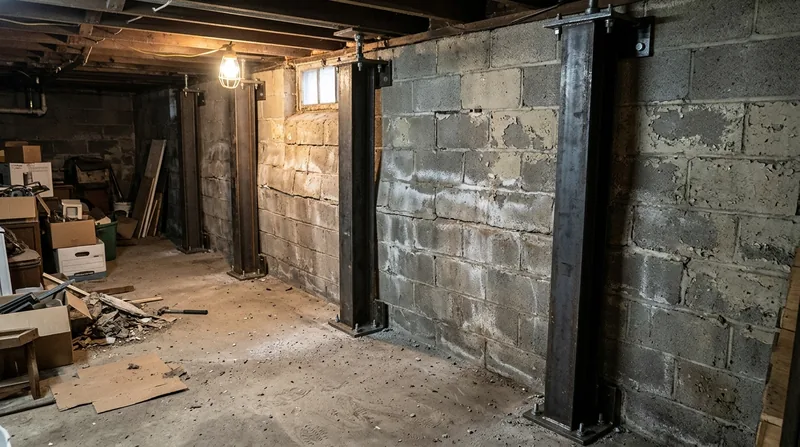




If you own an older home in REO Town, Old Town, or on the Westside, you may have noticed a basement wall that leans or bulges inward. Bowing Wall Repair in Lansing targets that movement before it becomes a structural emergency. Our city sits on glacial till and clay loam, and the Grand River and Red Cedar River floodplains keep the water table high through March and April. That spring saturation loads clay against fieldstone, early poured concrete, and block walls in 1900s-1930s bungalows and foursquares, and the pressure has to go somewhere. We stabilize leaning walls with carbon fiber straps, steel I-beams, or wall anchors matched to the severity of the movement and your soil. If you are also seeing water at the wall base, start with a free basement inspection so we can separate structural movement from a drainage problem.
Why Bowing Walls Are Common in Lansing's Older Basement Stock
Most bowing walls we open up in Lansing trace back to hydrostatic pressure, not to a single event. Glacial clay soil holds water, and when the water table rises in spring it pushes against basement walls that were never designed for that load. Fieldstone and early block walls in Moores Park and the Eastside are especially vulnerable because the mortar and block joints soften over decades. Long freeze-thaw winters also open hairline cracks that let water in and accelerate the damage.
- You see a horizontal crack near the middle of the wall, often with efflorescence or white powder along it.
- The top or bottom of the wall kicks inward while the middle stays put, which signals a different failure mode than a uniform bulge.
- Doors and windows stick on the floor above because the wall movement is transferring into the frame.
- You find previous parging or patching that has cracked and separated, meaning the movement continued under the repair.
Any one of these signs is reason to get the wall looked at before the spring thaw adds more load.
Key info: A 1920s foursquare near Old Town with a fieldstone wall and a horizontal crack at mid-height is a classic Lansing bowing wall. The clay behind it stays saturated well into April, so we measure the deflection and check the footing before choosing a repair method.
Structural repair permits in Michigan are handled at the local level, and the City of Lansing sets its own requirements for foundation work. Check the City of Lansing building department for current rules before any structural work begins.
How We Diagnose and Stabilize a Bowing Wall in Lansing
We do not sell a strap to every leaning wall. The first step is figuring out how far the wall has moved, what the soil is doing, and whether the footing is involved. That determines whether carbon fiber, steel, or anchors is the right call, and whether drainage work has to come first. Skipping that step is how homeowners end up paying twice.
- We measure the wall deflection with a plumb line and a level, and we map cracks, efflorescence, and any prior patching.
- We check the exterior grade, downspout extensions, and the footing drain to see how much water is reaching the wall.
- We inspect the interior perimeter and sump basin, because a wet wall and a bowing wall often share the same water source.
- We match the repair to the movement: carbon fiber straps for minor to moderate bowing, steel I-beams for heavier loads, wall anchors when the wall must be pulled back.
- We address the water side with drainage or sealing so the repaired wall is not reloaded next spring.
The goal is a wall that stops moving and stays put through the next thaw cycle.
Key info: In a 1950s ranch in Holt, we found a block wall bowed about 1.5 inches at mid-height with a wet base. Carbon fiber straps stabilized the wall, and an interior drain tile system took the hydrostatic pressure off the footing. Repairing the wall alone would have left the water problem in place.
If the wall is moving but the basement is dry, the repair can stand on its own. If water is part of the picture, pair the structural work with interior basement waterproofing so the same pressure does not return.
Repair Methods We Use and When Each One Fits
No single method fits every wall. The right choice depends on how much the wall has moved, what the wall is made of, and what the soil is doing. Here is how we match the approach to the condition we find.
| Approach | Description | Best for |
|---|---|---|
| Carbon fiber straps | Straps bonded vertically to the wall to stop further inward movement. | Minor to moderate bowing with no footing failure. |
| Steel I-beams | Beams set against the wall and tied into the floor and joists. | Heavier loads and block walls with significant deflection. |
| Wall anchors | Anchors driven into stable soil and connected to the wall to pull it back. | Walls that have moved but can still be straightened. |
| Drainage correction | Interior drain tile, sump basin, or exterior work to relieve pressure. | Wet walls and saturated clay soil behind the wall. |
We often combine two methods when the wall has moved and the soil is loading it at the same time.
Bowing Wall Repair Cost in Lansing: What to Expect
Most bowing wall repairs in Lansing start from $600 for a single-strap stabilization on a small section, and the price climbs from there. The biggest cost drivers are the length of wall involved, the method (carbon fiber is less expensive than steel or anchors), and whether drainage work is needed to relieve the pressure. Access matters too: a finished basement wall with paneling and insulation takes more prep than a bare block wall in an unfinished Eastside basement.
We give you a written scope before any work starts, and we tell you plainly when a simple crack seal is enough and when the wall needs structural stabilization. Getting two or three estimates is smart, but compare the scope, not just the number, because one bid may leave the water problem out. Our full pricing overview breaks down what each method includes.
What to Look for When Hiring a Bowing Wall Repair Contractor Near Lansing
Bowing wall work is structural, so the contractor you hire matters more than the price tag. Ask for proof of license and insurance before anyone touches the wall, and get the certificate sent to you directly. Ask how they diagnose the movement, and be wary of a bid that quotes a method before anyone has measured the wall.
Check references from jobs in Lansing, East Lansing, or DeWitt with similar wall construction, and confirm who pulls the permit. Local building departments set their own rules for structural repair, so the contractor should know the process in your jurisdiction. If you are in an HOA, confirm any exterior or drainage changes are allowed before work starts. You can contact us to schedule a free inspection and get a straight answer on what your wall needs.
Bowing Wall Repair in Lansing: Pricing Guide
| Service | Price | Details |
|---|---|---|
| Single-wall carbon fiber stabilization | Starting at $600 | Covers minor bowing on a short wall section, including strap layout and surface prep. |
| Steel I-beam reinforcement | Starting at $1,800 | Includes beam placement and tie-in to floor and joists; wall length and access drive the price. |
| Wall anchor system | Starting at $2,500 | Anchors set in stable soil to pull the wall back; soil conditions and wall length move the number. |
| Combined structural and drainage repair | On estimate | Needs an on-site look because the drainage scope and wall method are priced together. |
| Travel | Included | in Lansing and surrounding areas, no separate call-out or mileage fee |
| Estimate | Free | Response within 24h at (517) 220-0430, no obligation to book |
Indicative pricing, the exact cost depends on square footage, finish, and site access. Free personalized estimate within 24h at (517) 220-0430.


