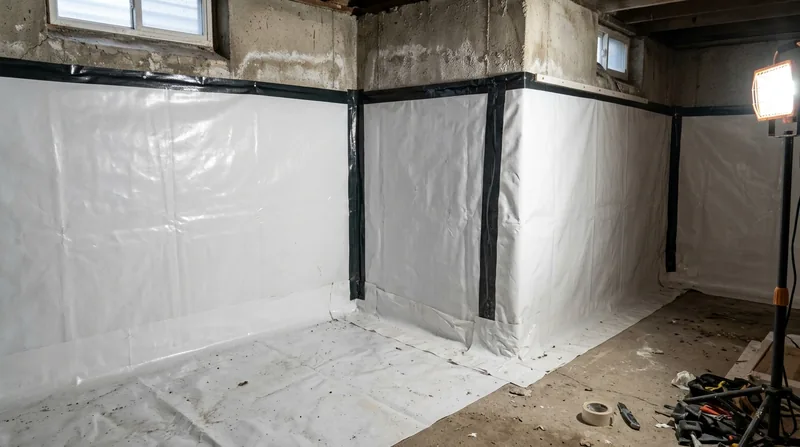




Vapor Barrier Installation in Lansing: Stop the Clay Damp Before It Spreads
If you own a 1920s foursquare in REO Town or a 1960s ranch in Okemos, you already know the pattern: every March the basement smells like wet dirt, the block walls sweat, and white powder blooms along the mortar joints. That is Vapor Barrier Installation in Lansing territory, not a crack you can just caulk. Our glacial clay loam and high spring water table push moisture vapor straight through fieldstone, early poured concrete, and block. We install heavy-duty vapor barrier sheets across walls and slab, seal the seams, tape the terminations, and tie the system into the sump basin where needed. You get a drier lower level and a basement that stops feeding mold growth. Start with a free basement inspection so we can map where the vapor is actually entering.
Why Lansing Basements Sweat: Glacial Clay, High Water Table, and Old Walls
Lansing sits on glacial till and clay loam, and the Grand River and Red Cedar River floodplains keep the water table high through March and April. That clay holds water like a sponge and releases it slowly as vapor. In the 1900s-1930s brick and frame bungalows of Old Town and the Westside, the fieldstone and early poured walls are porous enough that vapor moves through the wall itself, not just the joints. Snowmelt and summer storm runoff add to the load, and long freeze-thaw winters open hairline cracks that let more moisture in.
- Efflorescence on block and brick walls tells you soluble salts are migrating with moisture vapor.
- Musty basement smell is the first sign that moisture is feeding mold growth on joists, boxes, and stored materials.
- Damp slab and sweating pipes in summer point to vapor coming up through the concrete, not a leak.
- Peeling paint and rusted steel on the lower wall show chronic vapor drive, not a one-time flood.
When you see two or more of these, the fix is a continuous vapor barrier, not another coat of sealer.
Key info: In Moores Park and the Eastside, we routinely find 1950s partly finished basements where the lower wall was framed tight against damp block. The vapor barrier goes on the wall first, then the framing, so the moisture never reaches the insulation.
For the official word on basement moisture and mold prevention, the EPA's mold guidance is a solid plain-language reference.
How We Install a Vapor Barrier in a Lansing Basement
We do not staple plastic to a wall and call it done. A vapor barrier has to be continuous, sealed, and integrated with the drainage path, or it traps moisture behind itself and makes the problem worse. Our sequence is built for Lansing's clay soil and high spring water table, and it works on fieldstone, block, and poured walls alike.
- Inspect and moisture-map the walls, slab, and cove joint to locate the vapor source and check for active seepage.
- Correct drainage first by confirming the interior perimeter drain and sump basin are clear and the check valve holds.
- Prep the surface by removing loose parging, efflorescence, and any failed coatings so the barrier sits flat.
- Install heavy-duty barrier sheets from the cove joint up to the rim, overlapping courses and sealing every seam with compatible tape.
- Tape terminations at the slab, rim, penetrations, and sump basin so no edge is left open.
- Tie into the sump with a sealed boot and route the discharge line away from the foundation.
- Verify and hand off by checking adhesion, seam integrity, and drainage flow before we leave.
If the inspection shows active wall seepage, we address that with basement wall sealing before the barrier goes up.
Key info: A DeWitt split-level with a 1980s poured wall had a damp slab and a musty smell every spring. The footing drain was working, but the wall had no vapor control. We sealed the cove joint, installed the barrier to the rim, and tied the base into the existing sump. The basement stayed dry through the next snowmelt.
Vapor Barrier Approaches We Use in Lansing Homes
Not every basement needs the same material or the same coverage. We match the approach to the wall type, the moisture reading, and whether the space is finished, partly finished, or bare. The table below shows the main options we install in Lansing and the surrounding towns.
| Approach | Description | Best for |
|---|---|---|
| Wall sheet vapor barrier | Heavy-duty sheet from cove joint to rim, sealed seams and taped terminations. | Block, poured, and parged walls with vapor drive. |
| Dimple board drainage mat | Drainage mat against the wall that lets water fall to the drain while blocking vapor. | Walls with active seepage above the cove joint. |
| Slab vapor barrier | Sheet over the concrete slab with sealed laps and taped perimeter. | Damp slabs and finished floors over concrete. |
| Sump-integrated barrier | Wall and slab barrier tied to the sump basin with a sealed boot. | Basements with an interior drain and sump pump. |
| Fieldstone-specific barrier | Surface prep and a flexible barrier fitted to uneven mortar joints. | 1900s-1930s bungalows and foursquares. |
We confirm the right approach during the inspection, and we tell you plainly when a simpler repair is enough.
Vapor Barrier Installation Cost in Lansing: What to Expect
Most vapor barrier work in Lansing starts from $3 per square foot of wall or slab covered, and the final number depends on how much surface we treat and how much prep the wall needs. A bare poured wall in a Holt subdivision is a different job from a fieldstone wall in Old Town with failing parging and uneven joints. Square footage, wall condition, and whether we tie into an existing sump are the biggest cost drivers.
- Wall condition: loose parging and efflorescence removal add labor before the barrier goes up.
- Coverage area: full perimeter plus slab costs more than walls only.
- Sump integration: a sealed boot and discharge routing add a modest line item.
- Access: tight stairs and finished ceilings slow the install and raise labor.
- Material grade: heavier sheet and dimple board cost more than standard roll stock.
Get two or three written estimates so you can compare scope, not just the bottom line. Our full pricing overview breaks down how we build a quote.
Vapor Barrier Installation Near Me: How to Vet a Contractor Near Lansing
Searching for vapor barrier installation near me in Lansing turns up plenty of names, and not all of them specialize in below-grade work. A general handyman can hang plastic; a waterproofing contractor reads moisture, checks the drain tile and sump, and knows when the barrier is the wrong answer. Ask the right questions before you sign.
- Confirm licensed and insured status and ask for a certificate of insurance before work starts.
- Get at least three written estimates that list materials, square footage, and prep work.
- Ask for local references from jobs in Lansing, East Lansing, or Okemos you can call.
- Check permit requirements with the local building department, since work that alters drainage or sump discharge may need one.
- Understand warranty terms and confirm the warranty is transferable.
We walk you through all of this before any work begins. Reach us through the contact page to schedule your free estimate.
Vapor Barrier Installation in Lansing: Pricing Guide
| Service | Price | Details |
|---|---|---|
| Wall vapor barrier only | Starting at $3/sq ft | Heavy-duty sheet, sealed seams, taped terminations; wall condition and prep drive the price up. |
| Wall and slab barrier | Starting at $4/sq ft | Full perimeter plus slab coverage with sealed laps; square footage and access move the number. |
| Dimple board drainage mat | Starting at $5/sq ft | Drainage mat against the wall for active seepage; wall height and prep affect the rate. |
| Sump-integrated barrier | On estimate | Barrier tied to the sump basin with sealed boot; needs an on-site look at the drain and discharge. |
| Travel | Included | in Lansing and surrounding areas, no separate call-out or mileage fee |
| Estimate | Free | Response within 24h at (517) 220-0430, no obligation to book |
Indicative pricing, the exact cost depends on square footage, finish, and site access. Free personalized estimate within 24h at (517) 220-0430.


